 EMZETT.
Camera
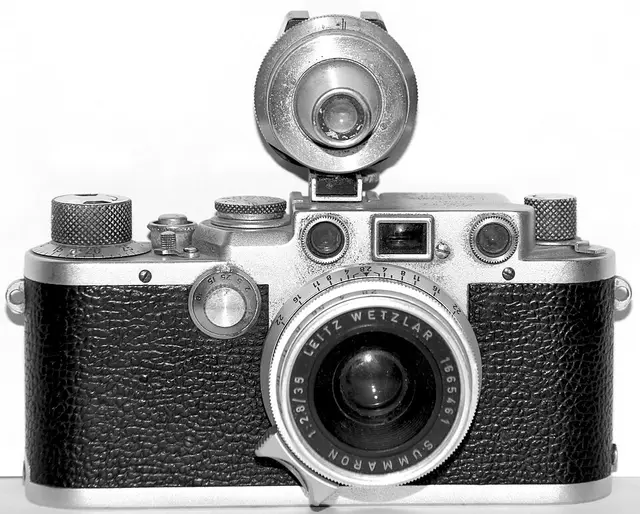 Image: Olga Ernst & Hp.Baumeler, CC BY-SA 4.0, Wikimedia Commons
 Photo:
In short: An input device that captures image or video signals — on computers, usually as a webcam for video calling or as a standalone recording device.
In more detail: Webcams are usually connected via USB and deliver their signal directly to software (e.g. video conferencing tools). External cameras without a direct USB output can be integrated via a capture card.
In Depth
A digital camera converts incoming light into electrical signals and then into digital image data via an image sensor (usually CMOS technology) — each pixel of the sensor measures the amount and colour of light hitting it. With integrated or USB webcams, a small, built-in processor directly handles the conversion and often an initial image compression (e.g. following MPEG standards), before the finished video signal is transmitted to the computer via USB — the computer itself then only has to receive and further process the already-compressed signal.
Important specs are the sensor resolution (how many pixels are captured), the frame rate (FPS, how many individual frames per second), and, for low light, the sensor’s light sensitivity. More professional cameras without their own USB output (e.g. DSLR or mirrorless cameras primarily built for photography) can be integrated into a PC via a capture card, which translates their HDMI video output into a signal usable by the computer — practical for higher-quality video conferencing or streaming with better image quality than a regular webcam.
Optical vs. digital zoom
An often-misunderstood distinction: optical zoom actually enlarges the image via the lens optics BEFORE the sensor, without loss of quality. Digital zoom, by contrast, crops a section out of the already-captured image afterwards and enlarges it computationally — this reduces the effective resolution and looks visibly blurry/pixelated at strong magnification. Most webcams have no optical zoom at all, only digital (or none at all) — an important purchasing criterion if actual image quality at magnification matters.
Image compression and bandwidth
Uncompressed video material would be far too data-heavy for live transmission — a single second of raw Full HD video alone can be several hundred megabytes. Compression methods like H.264 (a widespread MPEG successor standard) reduce this amount of data by a factor of 50-100, by exploiting similarities between consecutive frames (only changes are re-encoded, not every frame completely from scratch) — this is what makes video calling and streaming over normal internet connections practical at all.
See also: Microphone, Capture Card, MPEG, FPS