 EMZETT.
Windows
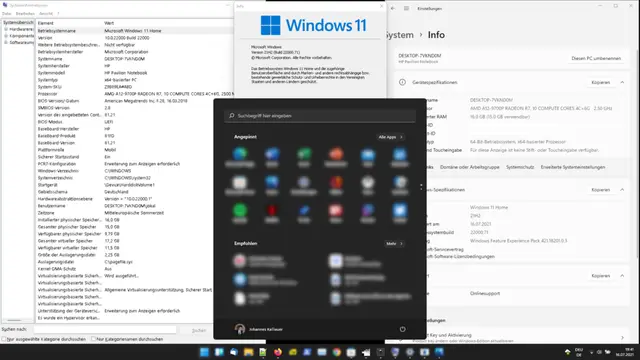 Image: Microsoft; Icons: https://notepad-plus-plus.org https://www.mozilla.org/de/fi…, Public domain, Wikimedia Commons

In short: The proprietary operating system developed by Microsoft — the most-used OS worldwide on desktop PCs.
In more detail: Known for broad hardware and software compatibility, as well as a graphical interface that has continuously evolved since the 1980s. Uses its own command lines like CMD and PowerShell for system control, unlike Unix-like systems such as Linux.
In Depth
Windows has dominated the desktop market since the 1990s, mainly because Microsoft relied on broad hardware compatibility from the start: unlike Apple’s tightly coupled hardware-software ecosystem, Windows runs on computers from practically any manufacturer and configuration. This openness also explains why Windows is so widespread in professional office environments and for gaming on desktop PCs — software and driver manufacturers primarily develop for Windows, because that’s where the largest user base is, which in turn attracts more users (a self-reinforcing network effect).
Under the hood, modern Windows is based on the Windows NT kernel (since Windows NT/2000, not to be confused with the older, technically fundamentally different Windows 9x versions). Several command-line tools are available in parallel for system control and automation: the old CMD (from the DOS era, simple batch scripts), the more modern, object-oriented PowerShell (more powerful, for more complex administration tasks), and, for a few years now, additionally WSL (Windows Subsystem for Linux), which integrates a real Linux kernel or environment directly under Windows — practical for developers who need Linux tools without switching operating systems.
Version history at a glance
Windows went through several fundamental architectural changes: the early versions (Windows 1.0-3.1) were actually just a graphical interface over MS-DOS, not a standalone operating system. Windows 95/98/ME (the “9x line”) first brought a more standalone architecture, but remained technically built on DOS foundations and were therefore unstable. Windows NT (developed in parallel, originally for servers/workstations) brought a fundamentally new, more robust kernel architecture, which became the standard for consumer PCs too from Windows XP (2001) onwards, and still forms the basis of every current Windows version today.
Licensing model and business strategy
Unlike Linux distributions (usually free, open source), Microsoft sells Windows licences both directly to end users and, on an even larger scale, bundled with newly sold hardware (“OEM licences”) — most newly bought PCs already come with Windows pre-installed, its licence cost included in the device price. This business model differs fundamentally from Apple’s approach (operating system only on its own hardware, essentially free as part of the hardware purchase) and from most Linux distributions (an open, usually free operating system, with a business model often based on support services rather than licence sales).
Windows in enterprise environments
In companies, Windows is usually managed centrally via Active Directory — a directory service that centrally controls user accounts, permissions and group policies for hundreds or thousands of computers at once, instead of having to configure each computer individually. This central manageability is one of the main reasons Windows continues to dominate in corporate environments despite competition from macOS/Linux, especially in larger organisations with corresponding IT departments.
See also: Linux, Operating System