 EMZETT.
TCP/IP Model
In short: The layered model of the internet with four layers: network access, internet, transport and application. It is the practical basis of almost all networks.
In more detail: The TCP/IP model (also called the DoD model) emerged in the 1970s around the ARPANET and describes how data gets from an application across the network to the application on another device. Unlike the seven-layer OSI model it merges several tasks and is closer to the real protocols.
In Depth
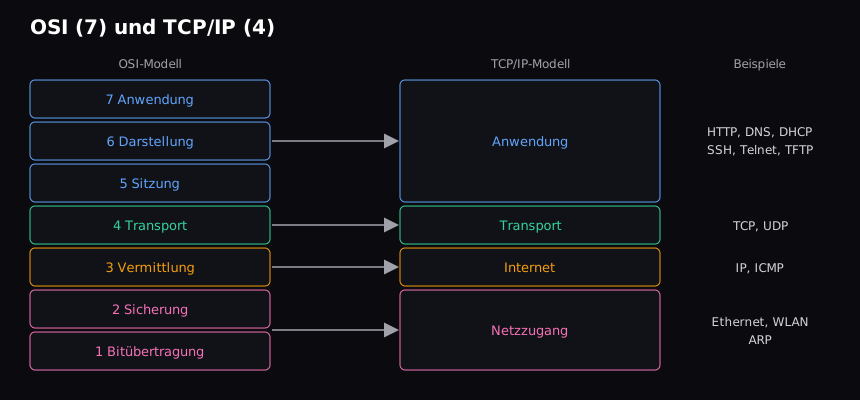
The four layers
| Layer | Task | Examples | OSI layers |
|---|---|---|---|
| Application | Services for programs | [[http | HTTP]], [[dns |
| Transport | End-to-end connection, ports | [[tcp | TCP]], [[udp |
| Internet | Addressing and routing | [[ip-adressen | IP]], [[icmp |
| Network access | Transmission in the local network | [[ethernet | Ethernet]], [[wlan |
Encapsulation: how data is packed
Each layer puts its own header in front of the data of the layer above. The payload becomes a TCP segment, then an IP packet and then an Ethernet frame. The receiver unpacks in the reverse order.
Example: loading a web page
- Application: The browser asks for a page via HTTP; DNS supplies the IP address beforehand.
- Transport: TCP opens a connection to port 443 using the three-way handshake.
- Internet: IP adds source and destination addresses to the segments; routers forward them.
- Network access: ARP finds the MAC address of the next device, Ethernet or Wi-Fi transmits the frames.
TCP/IP or OSI?
OSI is a teaching and reference model, in practice (and in administrators’ daily work) TCP/IP is used. Exams and books often use a five-layer hybrid model that splits network access into physical and data link.
Use in troubleshooting
You check from bottom to top: cable and link (network access), IP configuration with ipconfig (internet), reachability with ping, port reachability (transport), finally the service itself (application). See network commands in the CMD.
See also: OSI Model, TCP, UDP, IP Addresses, ICMP, ARP, Ethernet, HTTP, DNS, Packet, Network Protocols