 EMZETT.
Repeater
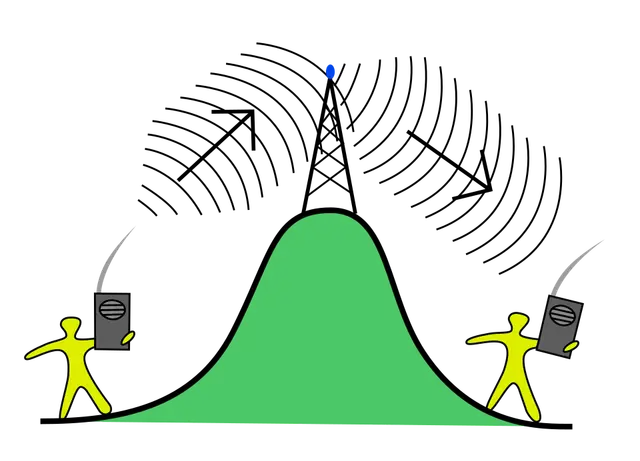 Image: Mouagip, Public domain, Wikimedia Commons

In short: A device that receives a network signal, refreshes it and sends it out again amplified, in order to extend a network’s usable range.
In more detail: Works at the lowest layer of the OSI model (physical layer) and doesn’t interpret the content of the data — it simply amplifies the electrical or radio signal. A Wi-Fi repeater is the best-known everyday case: it extends the Wi-Fi range into areas with a weak signal.
In Depth
An important difference from more intelligent devices such as switches or routers: a repeater doesn’t “understand” the data passing through at all — it knows neither MAC addresses nor IP addresses nor any higher protocol level, but purely amplifies the physical signal, regardless of what it contains. This makes it simple and cheap, but also inefficient: it amplifies every bit of noise and every collision contained in the original signal just the same, instead of correcting errors.
A Wi-Fi repeater (also called an extender) receives the router’s existing Wi-Fi signal and sends it out again under the same or a separate network name — in practice the effective data rate is often halved in the process, because the repeater has to use the same radio band for receiving and re-sending at the same time. More modern mesh Wi-Fi systems solve this problem more elegantly, with several access points coordinating intelligently with each other instead of just bluntly repeating.
How it differs from hub, switch and bridge
The distinction between network devices of the lower OSI layers can be pinned down by their “intelligence”: a repeater (layer 1) blindly amplifies every signal. A hub is basically a multi-port repeater — it doesn’t know any MAC addresses either and forwards every incoming signal unfiltered to all other ports, which can lead to collisions when several devices send at the same time. A bridge and a switch, on the other hand, work at layer 2 and read MAC addresses to forward data specifically only to the right port instead of blindly sending it to everyone — considerably more efficient, but also more complex and expensive than a pure repeater.
Historical significance
In the early days of Ethernet networks (with coaxial cables instead of modern twisted-pair cabling), repeaters were essential for overcoming the strict length limits of individual cable segments — the “5-4-3 rule” prescribed how many repeaters and cable segments could be connected in series at most before signal delays made the network unreliable. With the triumph of switches, which not only amplify signals but also actively regenerate them and forward them in a targeted way, the pure repeater was largely displaced from cable networks — but in the Wi-Fi world the concept lives on to this day as the extender.